


 Gift Box
 Almonds
 Cashew Nuts
 Pistachio
 Pine Nuts Chilgoza
 Walnuts
 Dried Fig
 Apricot
 Dates
 Peanuts
 Walnut Kernels


Dry Fruit Custard at Home: Recipe + Cost Guide
In short: Dry fruit custard is the quick chilled cousin of kheer — custard powder cooked in milk, chilled till set, and loaded with badam, kaju, pista giri, kishmish and coconut. One bowl makes 6 servings and costs Rs 850 for the shop-bought ingredients — about Rs 142 a serving. Custard powder and milk are bazaar-bought and not costed here, because the shop does not sell them. Where kheer takes an hour and a quarter of slow cooking, custard takes fifteen minutes — and it is the dessert you make when guests are coming in an hour.
Every Pakistani household knows the custard. It is the dessert of the unexpected guest, the after-school treat, the thing you make when the dawat menu needs one more sweet and the clock says otherwise. A packet of custard powder, a litre of milk, sugar from the jar — and twenty minutes later there is a bowl in the fridge, setting. Plain custard is fine. Dry fruit custard is the version worth writing about: the same quick base, but with five dry fruits folded in, so the bowl that comes out of the fridge has crunch and chew and colour in every spoon.
The honest comparison is with kheer, because the two desserts are cousins and everyone asks which one to make. Kheer is slow-cooked: rice in milk for an hour, stirred, watched, and thickened by patience. Custard is fast: powder in milk for ten minutes, stirred, chilled, and set by the fridge. Kheer is the winter dessert, served warm. Custard is the chilled dessert, served cold — which is why it works in every season, and why it is the one to make when you have no time and still want to serve something that looks like effort. This guide gives the full dry fruit custard recipe — the method, the portions, the storage, and the cost at today's live shop prices — as the next recipe in our winter-dessert series, after the kheer.
The Recipe: Dry Fruit Custard, Step by Step
Serves 6. Time: about 15 minutes, plus 2 hours chilling.
Ingredients. Full-cream milk 1 litre (ghar ka / bazaar, not costed); custard powder 4 tablespoons, vanilla flavour (bazaar, not costed); sugar 4 tablespoons, or to taste (bazaar, not costed); American badam 40g, blanched, peeled and slivered; raw kaju 40g, roughly chopped; pista giri 30g, slivered, for the top; desi kishmish 30g; dried coconut 30g, grated.
Step 1 — Soak the kishmish and prep the nuts. Put the kishmish in a small bowl of warm water for 10 minutes — it plumps up and loses its chewiness, so it melts into the custard instead of sitting hard in it. While it soaks, blanch the badam: pour boiling water over them, wait two minutes, and slip the skins off. Sliver the badam, chop the kaju roughly, and sliver the pista. Keep the pista separate — it goes on top at the end, not into the pot.
Step 2 — Mix the custard powder. Take 4 tablespoons of custard powder and mix it in a cup with 4 tablespoons of cold milk, taken from the litre. Stir until it is completely smooth, with no lumps at all. This is the step that decides whether your custard is silk or porridge: powder mixed into hot milk clumps instantly, and no amount of stirring afterwards will save it. Cold milk first, smooth paste, then heat.
Step 3 — Cook the custard. Bring the rest of the milk to a boil in a heavy pot, add the sugar, and stir until it dissolves. Turn the heat to low. Pour in the custard paste in a thin stream, stirring all the time with a whisk or a wooden spoon. Keep stirring for 3–4 minutes, until the custard thickens and coats the back of the spoon. It thickens fast — do not walk away from the pot, and do not stop stirring, or the bottom catches and the whole batch tastes burnt.
Step 4 — Fold in the dry fruit. Take the pot off the heat. Drain the kishmish and add it, with the badam, the kaju and the coconut, and stir them through the hot custard. The nuts soften slightly in the heat and give up a little of their flavour to the custard — which is the point. Do not add the pista yet: it stays crisp and green, and it goes on top.
Step 5 — Chill and serve. Pour the custard into a serving bowl, or into six small bowls. Press a piece of cling film or a plate directly onto the surface — this stops the skin from forming, and the skin is the one thing that ruins a custard. Chill in the fridge for at least 2 hours, until set. Sprinkle the slivered pista on top just before serving, so it stays green and crisp against the pale custard.
The one mistake. Mixing the custard powder into hot milk. It clumps the moment it hits the heat, and the lumps never dissolve. Cold milk first, smooth paste, then into the pot in a thin stream while stirring. If your custard has lumps in it, this is why — and the only fix is to start again, which takes ten minutes, so it is a cheap lesson.
The Ingredients, One by One
American badam — 250g Rs 1,100. The backbone nut, blanched and slivered, folded through the custard. The batch uses 40g, costed at Rs 176. Blanch and peel if you like the clean look; for custard, blanched and slivered is the tradition, and the peel has no place in a pale dessert.
Raw kaju — 250g Rs 1,400. The creamy nut, chopped, for the softness of the custard. The batch uses 40g, costed at Rs 224. Buy raw, not salted — salt has no place in a custard, and roasted kaju goes soft in the wrong way.
Pista giri — 250g Rs 2,750. The garnish and the luxury: slivered on top, not cooked in, so the green shows against the pale custard. The batch uses 30g, costed at Rs 330. It is the most expensive item per gram on this list — if the budget is tight, halve it to 15g and the custard is still complete, because the top needs less than you think.
Desi kishmish — 250g Rs 500. The small sweetness inside the custard, plumped by a soak in warm water before it goes in. The batch uses 30g, costed at Rs 60. Pick out the stems first; a stem in a custard is the one flaw nobody forgives, and a hard kishmish is the second.
Dried coconut — 250g Rs 500. The chew and the milkiness. The batch uses 30g, costed at Rs 60. Grated or desiccated both work; long shreds do not — cut them short so the custard spoons smoothly and the coconut does not string across the bowl.
Custard powder and milk — not costed. Say it plainly, because the shop's own catalogue says it: custard powder and milk are NOT sold on the Shopify shop — they are bazaar and ghar ka. Buy a packet of vanilla custard powder from your usual shop and milk from your doodhwala, at your own local price. This guide does not invent a price for either of them, because there is no shop price to quote. Sugar is bazaar too.
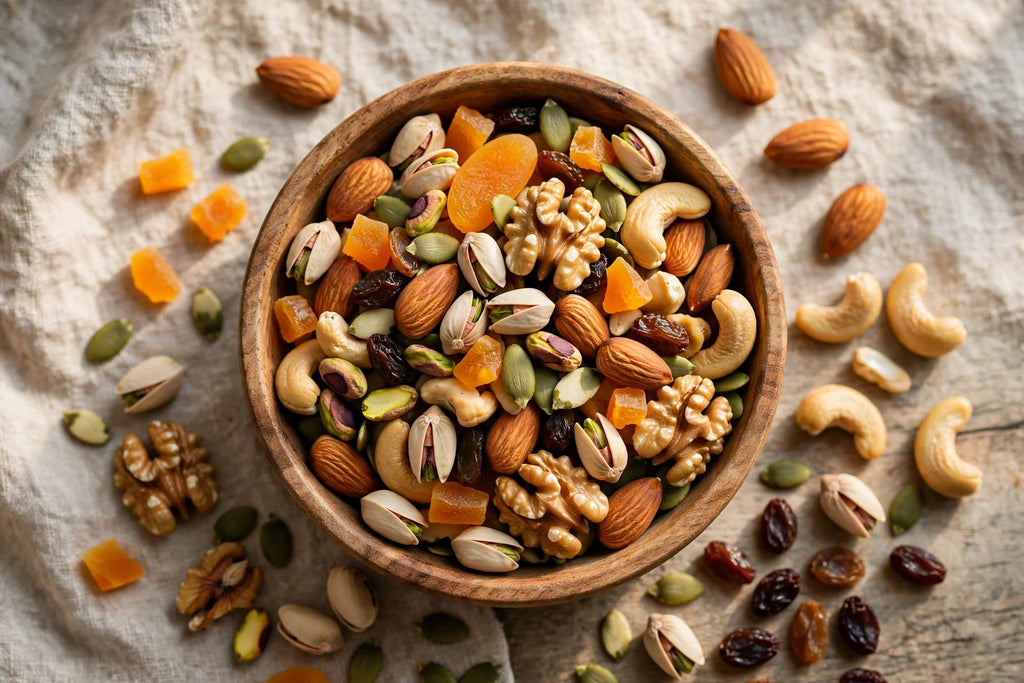
The Costed List: One Bowl, 6 Servings
Every price is the shop's own live price on 11 November 2026. The batch is costed by the amount used, from the verified pack price:
| Item (Shopify store) | Pack price | Used in bowl | Bowl cost |
|---|---|---|---|
| American Badam | 250g Rs 1,100 | 40g | Rs 176 |
| Raw Kaju | 250g Rs 1,400 | 40g | Rs 224 |
| Pista Giri (garnish) | 250g Rs 2,750 | 30g | Rs 330 |
| Desi Kishmish | 250g Rs 500 | 30g | Rs 60 |
| Dried Coconut | 250g Rs 500 | 30g | Rs 60 |
| Custard powder, milk, sugar | — | 4 tbsp / 1L / 4 tbsp | Bazaar, not costed |
| Total — one bowl, 6 servings | — | — | Rs 850 |
| Per serving (6 servings) | — | — | ~Rs 142 |
Rs 850 a bowl is the shop-bought cost; the custard powder, milk and sugar from your kitchen sit on top of it, at your own local price. The packs you buy go further than one bowl: the 250g badam and kaju packs make six bowls each, and the 250g kishmish and coconut packs make eight. The second bowl, from the same shopping, costs far less than the first — which is the real economics of homemade custard. Skip the pista garnish and the bowl falls to Rs 520, or about Rs 87 a serving — still a dry fruit custard, just a plainer one.
Portions, Storage and Serving
Portion. One bowl (about 150g) is a serving — roughly Rs 142 of shop-bought ingredients, plus the custard powder and milk from your kitchen. Two bowls is a generous serving, and the second bowl is the one children ask for. Anyone watching sugar should take a small bowl and skip the second: the custard has 4 tablespoons of sugar in the bowl, and that is real.
Cold is the point. Custard is a chilled dessert: serve it straight from the fridge, when it is set and cold. It is the dessert for the guest who arrives in an hour, and for the summer evening, and for the winter night when the kheer feels like too much work. Never serve it warm — warm custard is a sauce, not a dessert, and it tastes of the pot.
Storage. A covered bowl in the fridge: two to three days. Press cling film onto the surface before you chill it, and the custard will not form a skin. The pista garnish goes on at serving time, not before — pista left on a chilled custard overnight goes soft and loses its green. Do not freeze custard: it turns watery when it thaws, and the dry fruit goes rubbery. If it smells sour, throw it away — milk does not negotiate.
Serving. Small bowls, not big ones: custard is rich, and a small bowl finished is better than a big bowl left half-eaten. Garnish each bowl with a few slivers of pista and a pinch of coconut, and serve it after the main course, with nothing else — the custard is the dessert, and it does not need company.
How do you make dry fruit custard at home?
Mix 4 tablespoons of custard powder in a little cold milk until smooth, then pour it into 1 litre of boiling milk with sugar, stirring for 3–4 minutes until thick. Take it off the heat, fold in soaked kishmish, slivered badam, chopped kaju and grated coconut, pour into bowls, cover the surface, and chill for 2 hours. Sprinkle slivered pista on top just before serving.
How much does a bowl of dry fruit custard cost?
Rs 850 for the shop-bought ingredients in one bowl of 6 servings — about Rs 142 a serving. Custard powder, milk and sugar are bazaar and are not costed, because the shop does not sell them. Skip the pista garnish and the bowl falls to Rs 520.
Is dry fruit custard the same as kheer?
No — they are cousins, not twins. Kheer is slow-cooked rice in milk for over an hour and is served warm; custard is custard powder in milk for ten minutes and is served chilled. Custard is the quick version: fifteen minutes of work and two hours in the fridge. See our dry fruit kheer recipe for the slow-cooked classic.
Why does my custard have lumps?
Because the powder went into hot milk. Always mix custard powder into a little cold milk first, until completely smooth, then pour it into the boiling milk in a thin stream while stirring. Powder mixed into hot milk clumps instantly, and the lumps never dissolve.
How long does dry fruit custard keep?
Two to three days in a covered bowl in the fridge, with cling film pressed onto the surface to stop a skin forming. Add the pista garnish at serving time, not before. Do not freeze it, and do not leave it out overnight — milk goes off, and a sour custard is a wasted bowl.
Make Your Custard: Order from Khan Dry Fruits — American badam 250g (Rs 1,100), raw kaju 250g (Rs 1,400), pista giri 250g (Rs 2,750), desi kishmish 250g (Rs 500): the core four for a bowl of custard. Delivery across Pakistan. Browse the News blog →
Related: Dry Fruit Kheer at Home: Recipe + Cost for 6 Servings · Dry Fruit Laddu at Home: Gond Laddu Recipe + Cost · Dry Fruit Doodh: Badam Doodh Premix Recipe


