


 Gift Box
 Almonds
 Cashew Nuts
 Pistachio
 Pine Nuts Chilgoza
 Walnuts
 Dried Fig
 Apricot
 Dates
 Peanuts
 Walnut Kernels


Dry Fruit Cake Recipe: Christmas Bake Cost Guide 2026
In short: A dry fruit cake is the Christmas bake — dried fruit and nuts soaked overnight, folded into an eggless sponge, baked slow and fed weekly till Christmas. One 1kg cake costs Rs 1,408 for the shop-bought dry fruits and nuts — about Rs 141 a slice (10 slices). This is the Pakistani version: eggless, and soaked in black tea, not brandy — no alcohol anywhere in it. Maida, butter, sugar and baking soda are bazaar-bought and not costed here, because the shop does not sell them. Stir-up Sunday, the traditional last day to bake, is 22 November 2026 — bake it this week, feed it once a week, and it is ready for Christmas Day.
Christmas baking season opened this week. The food blogs know it: a traditional British Christmas cake was published on 5 November 2026, an eggless Christmas fruit cake was updated on 9 November, and a full guide to making a Christmas cake — with its fruit-feeding and timing — was published on 10 November. The message from all of them is the same: a Christmas cake is not baked on Christmas Eve. It is baked weeks early, fed weekly, and left to mature, so that by Christmas Day it is dark, moist and rich in a way no cake baked the same week can ever be. The deadline has a name — Stir-up Sunday, the last Sunday before Advent — and in 2026 it falls on 22 November. That is ten days from today. This is a bake-it-now topic, not an evergreen one: every week you wait is a week of feeding lost.
This is also a cake adapted honestly for a Pakistani kitchen. Two things are different from the British original, and both are stated plainly. First, it is eggless: no eggs anywhere in it, with curd and milk doing the binding instead. Second, it is non-alcoholic: the fruit is soaked in strong black tea, not brandy. The British tradition soaks its fruit in brandy for weeks; this version soaks it in black tea overnight, and the tea does the same work — it plumps the fruit, darkens the crumb and adds depth — without a drop of alcohol. If a recipe tells you brandy is essential, it is wrong: what is essential is a long soak in something dark and flavourful, and black tea is exactly that. There is no brandy in this cake, no rum, no sherry, and nothing to feed it with except more tea.
One more honest note up front: this is the first cake article on either of our sites — the word "cake" returned zero hits on both the Shopify and Laravel blog sitemaps on 12 November — so there is no earlier cake to link back to. What there is, is the winter-dessert series it joins: the dry fruit kheer, the dry fruit custard and the dry fruit honey jar, all of which use the same nuts and the same shop, in different forms.
The Recipe: Dry Fruit Cake, Step by Step
Makes one 1kg cake, 10 slices. Time: overnight soak + about 1 hour 15 minutes baking, plus cooling.
Ingredients. For the soak: desi kishmish 80g; dried figs (anjeer) 50g, chopped; dried coconut 30g, grated; green pumpkin seeds 30g; strong black tea 150ml, cooled. For the cake: American badam 50g, chopped; raw kaju 50g, chopped; pista giri 30g, chopped; maida 200g (bazaar, not costed); butter 100g, softened (bazaar, not costed); sugar 120g (bazaar, not costed); fresh curd 100g (ghar ka / bazaar, not costed); milk 4 tablespoons (ghar ka / bazaar, not costed); baking soda 1 teaspoon (bazaar, not costed); green elaichi 3 pods, seeds crushed; a pinch of jaifal (nutmeg), optional.
Step 1 — Soak the fruit overnight. Put the kishmish, chopped anjeer, coconut and pumpkin seeds in a bowl and pour the cooled black tea over them. Cover and leave overnight, at least 8 hours. The tea plumps the fruit and darkens it, and the fruit drinks the tea until it is soft and heavy. This is the step that makes a Christmas cake a Christmas cake: fruit soaked overnight bakes into a moist crumb, and fruit thrown in dry bakes into a cake that dries out by the second day. Do not skip the soak, and do not shorten it to an hour — overnight is the minimum, and a full day is better.
Step 2 — Cream the butter and sugar. Beat the softened butter and the sugar together until pale and fluffy, about 3–4 minutes with a hand beater or a strong arm and a wooden spoon. Add the curd and beat again until smooth — the curd is the egg in this cake, and it is what binds the crumb and keeps it moist. Stir in the milk, the crushed elaichi seeds and the pinch of jaifal. The batter will look loose; that is right, because the flour and the soaked fruit are still to come.
Step 3 — Fold in the flour and the fruit. Sift in the maida and the baking soda and fold gently until just combined — no beating, or the cake turns tough. Then fold in the soaked fruit with all its tea, and the chopped badam, kaju and pista. The batter should be thick, heavy and studded with fruit; if it looks dry, add milk a tablespoon at a time. The fruit is the cake here, not a decoration: a Christmas cake is mostly fruit held together with sponge, and a cake that is mostly sponge with a little fruit is just a plain cake with raisins in it.
Step 4 — Bake it slow. Line a 7-inch round tin with butter paper, spoon in the batter and level the top. Bake at 160°C for 1 hour 10 minutes to 1 hour 20 minutes, until a skewer comes out clean and the top is dark brown. Cover the top loosely with foil after 45 minutes if it is browning too fast — a Christmas cake is a slow, low bake, and a hot oven burns the top while the middle stays raw. Leave the cake in the tin for 15 minutes, then turn it out onto a rack and let it cool completely before you touch it again.
Step 5 — Feed it weekly till Christmas. Once the cake is completely cool, wrap it tightly in butter paper and then in foil, and store it in an airtight box. Once a week, unwrap it, brush the top with two tablespoons of strong black tea, and wrap it up again. That is the feeding: a little tea, once a week, every week till Christmas. Each feed keeps the cake moist and deepens its flavour, and a cake fed four times tastes like a different cake from one baked and forgotten. If you baked last weekend, the first feed falls on 15 November — and the last feed is the week of Christmas itself.
The one mistake. Baking it too hot, or baking it too late. A Christmas cake baked at 180°C is burnt on top and raw in the middle, and a Christmas cake baked on 23 December is a plain fruit cake, not a Christmas cake — it has had no time to mature. Low oven, early bake, weekly feeds: those three things are the recipe, and everything else is detail.
The Ingredients, One by One
American badam — 250g Rs 1,100. The backbone nut, chopped, folded through the cake for crunch. The cake uses 50g, costed at Rs 220. Chop it coarse — fine badam disappears into the crumb, and a Christmas cake should have nuts you can see and bite.
Raw kaju — 250g Rs 1,400. The creamy nut, chopped, for the softness of the crumb. The cake uses 50g, costed at Rs 280. Buy raw, not salted and not roasted — salt has no place in a cake. Use the live price: the shop's own product FAQ still shows an older figure in places, but the buy box and the live price are Rs 1,400, and Rs 1,400 is what is costed here.
Pista giri — 250g Rs 2,750. The green nut, chopped, for colour and luxury in every slice. The cake uses 30g, costed at Rs 330. It is the most expensive item per gram on this list — if the budget is tight, halve it to 15g and the cake is still complete, because the cake has six other fruits and nuts in it.
Desi kishmish — 250g Rs 500. The small sweetness, plumped overnight in black tea. The cake uses 80g, costed at Rs 160. Pick out the stems first; a stem in a cake is the one flaw nobody forgives.
Dried figs (anjeer) — 250g Rs 1,400. The dark, chewy fruit, chopped, for depth. The cake uses 50g, costed at Rs 280. Use the dried-figs listing at Rs 1,400 — not the Turkish anjeer, which is out of stock on both sites and must not be ordered. Chop it small, or the pieces sink to the bottom of the tin.
Dried coconut — 250g Rs 500. The chew and the milkiness, soaked with the fruit and folded in. The cake uses 30g, costed at Rs 60. Grated or desiccated both work; long shreds do not — cut them short so the cake slices cleanly.
Green pumpkin seeds — 250g Rs 650. The crunch on top and through the crumb, the newest addition to the Christmas cake and the one that makes it look modern. The cake uses 30g, costed at Rs 78. Use the Shopify price of Rs 650: the same seeds cost more on our other shop, and this article costs the Shopify shop only.
Maida, butter, sugar, curd, milk, baking soda, tea and spices — not costed. Say it plainly, because the shop's own catalogue says it: maida, butter, sugar, baking soda, fresh milk, curd and black tea are NOT sold on the Shopify shop — they are bazaar and ghar ka. Buy them from your usual shop and your doodhwala, at your own local prices. This guide does not invent a price for any of them, because there is no shop price to quote. The elaichi and jaifal come from your spice box; tutti-frutti and candied peel are not sold by the shop either, and are not in this cake — the dried fruit does the work instead.
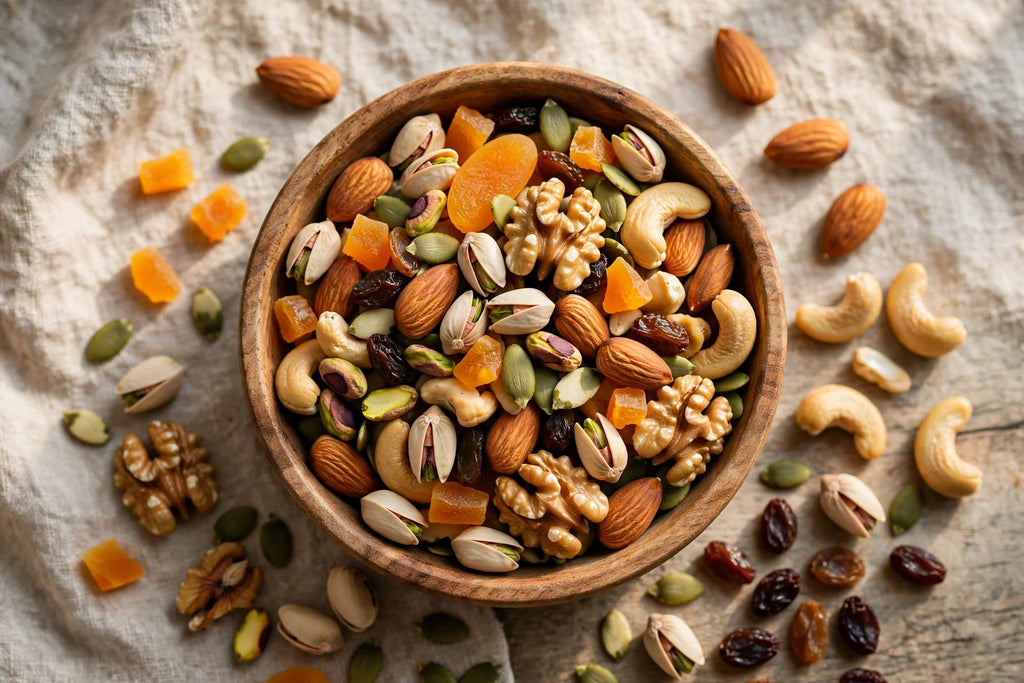
The Costed List: One 1kg Cake, 10 Slices
Every price is the shop's own live price on 12 November 2026. The cake is costed by the amount used, from the verified pack price:
| Item (Shopify store) | Pack price | Used in cake | Cake cost |
|---|---|---|---|
| American Badam | 250g Rs 1,100 | 50g | Rs 220 |
| Raw Kaju | 250g Rs 1,400 | 50g | Rs 280 |
| Pista Giri | 250g Rs 2,750 | 30g | Rs 330 |
| Desi Kishmish | 250g Rs 500 | 80g | Rs 160 |
| Dried Figs (Anjeer) | 250g Rs 1,400 | 50g | Rs 280 |
| Dried Coconut | 250g Rs 500 | 30g | Rs 60 |
| Green Pumpkin Seeds | 250g Rs 650 | 30g | Rs 78 |
| Maida, butter, sugar, curd, milk, baking soda, tea | — | 200g / 100g / 120g / 100g / 4 tbsp / 1 tsp / 150ml | Bazaar, not costed |
| Total — one 1kg cake, 10 slices | — | — | Rs 1,408 |
| Per slice (10 slices) | — | — | ~Rs 141 |
Rs 1,408 a cake is the shop-bought cost; the maida, butter, sugar, curd and milk from your bazaar sit on top of it, at your own local prices. The packs you buy go further than one cake: the 250g badam and kaju packs make five cakes each, and the 250g kishmish pack makes three. The second cake, from the same shopping, costs far less than the first — which is the real economics of a homemade Christmas cake. Against a bakery Christmas cake, which sells for several thousand rupees a kilo, a home cake at Rs 141 a slice is the honest price of a real fruit cake, made with real fruit.
Portions, Storage and Serving
Portion. One slice (about 100g) is a serving — roughly Rs 141 of shop-bought ingredients, plus the maida and butter from your bazaar. Two slices is a generous serving, and the second slice is the one people take with their evening chai. Anyone watching sugar should take one thin slice and stop: the cake has 120g of sugar in it plus the sugar in the fruit, and that is real.
Serving. Serve the cake at room temperature, in thin slices, with chai or doodh — the way Christmas cake has always been served, and the way it will always be served. It is a gift cake as much as a table cake: wrap a cooled cake in butter paper and foil, tie it with a ribbon, and it travels well, looks generous, and arrives intact. A homemade Christmas cake is a better gift than a bakery box, because the person who receives it can taste that it was soaked and fed by hand.
Storage. A wrapped cake in an airtight box at room temperature: four to six weeks, improving every week it is fed. That is the point of a Christmas cake — it is the one cake that gets better with time, not worse. Once cut, keep the cut face covered with butter paper and the cake will stay moist for two weeks. It freezes well, too: wrap a whole cooled cake tightly, freeze for up to three months, and thaw overnight in the fridge.
The timeline, once more. Soak the fruit tonight. Bake by Stir-up Sunday, 22 November 2026 — earlier is better, and this week is ideal. Feed once a week with two tablespoons of strong black tea. Serve on Christmas Day. Four feeds between baking and Christmas is the minimum for a cake that tastes like Christmas; six feeds is the cake people remember.
How do you make a dry fruit cake for Christmas?
Soak kishmish, anjeer, coconut and pumpkin seeds in strong black tea overnight. Cream butter and sugar, add curd and milk, then fold in maida, baking soda and the soaked fruit with chopped badam, kaju and pista. Bake slow at 160 degrees for about 1 hour 15 minutes. Cool, wrap, and feed once a week with black tea until Christmas.
Is this dry fruit cake eggless?
Yes. There are no eggs anywhere in it — curd and milk do the binding instead. It is also non-alcoholic: the fruit is soaked in black tea, not brandy, and it is fed with black tea, not brandy. No alcohol is used at any stage.
When should I bake a Christmas cake?
By Stir-up Sunday, 22 November 2026 — the traditional last day to bake. Earlier is better: bake this week and you get four to six weekly feeds before Christmas. A cake baked on 23 December has had no time to mature and is just a plain fruit cake.
How much does a homemade dry fruit cake cost?
Rs 1,408 for the shop-bought dry fruits and nuts in one 1kg cake of 10 slices — about Rs 141 a slice. Maida, butter, sugar, curd, milk and baking soda are bazaar and are not costed, because the shop does not sell them. The 250g nut packs make five cakes each.
How long does a Christmas cake keep?
Four to six weeks wrapped in an airtight box at room temperature, improving every week it is fed — and up to three months in the freezer. Once cut, keep the cut face covered with butter paper and it stays moist for two weeks.
Bake Your Cake: Order from Khan Dry Fruits — American badam 250g (Rs 1,100), raw kaju 250g (Rs 1,400), pista giri 250g (Rs 2,750), desi kishmish 250g (Rs 500): the core four for a Christmas cake. Delivery across Pakistan. Browse the News blog →
Related: Dry Fruit Kheer at Home: Recipe + Cost for 6 Servings · Dry Fruit Custard at Home: Recipe + Cost Guide · Dry Fruit Honey Jar: Recipe + Cost


