


 Gift Box
 Almonds
 Cashew Nuts
 Pistachio
 Pine Nuts Chilgoza
 Walnuts
 Dried Fig
 Apricot
 Dates
 Peanuts
 Walnut Kernels


Dry Fruit Daliya Porridge: Winter Breakfast Recipe
In short: Dry fruit daliya porridge is the winter breakfast that needs no occasion: broken wheat simmered in warm milk with badam, kaju, kishmish, akhrot, khajoor and char magaz, sweetened with a spoon of honey. One pot makes about 4 bowls and costs Rs 588 in shop-bought ingredients — about Rs 147 a bowl. The daliya and the milk come from the bazaar, not from this shop, so they are not costed here. It is the breakfast that warms the house before the day starts, and it is ready in half an hour.
Winter mornings in Pakistan have a smell, and it is the smell of something warm on the stove. In some houses it is chai. In others it is paratha. And in the houses that know daliya, it is porridge — broken wheat, simmered slow in milk, until it turns thick and creamy and the whole kitchen smells of wheat and warmth. Daliya porridge is not a fancy breakfast. It is not a celebration food, and it is not a guest food. It is the everyday winter breakfast, the one that gets the family out of bed and out of the door, fed and warm, and it has been that for generations.
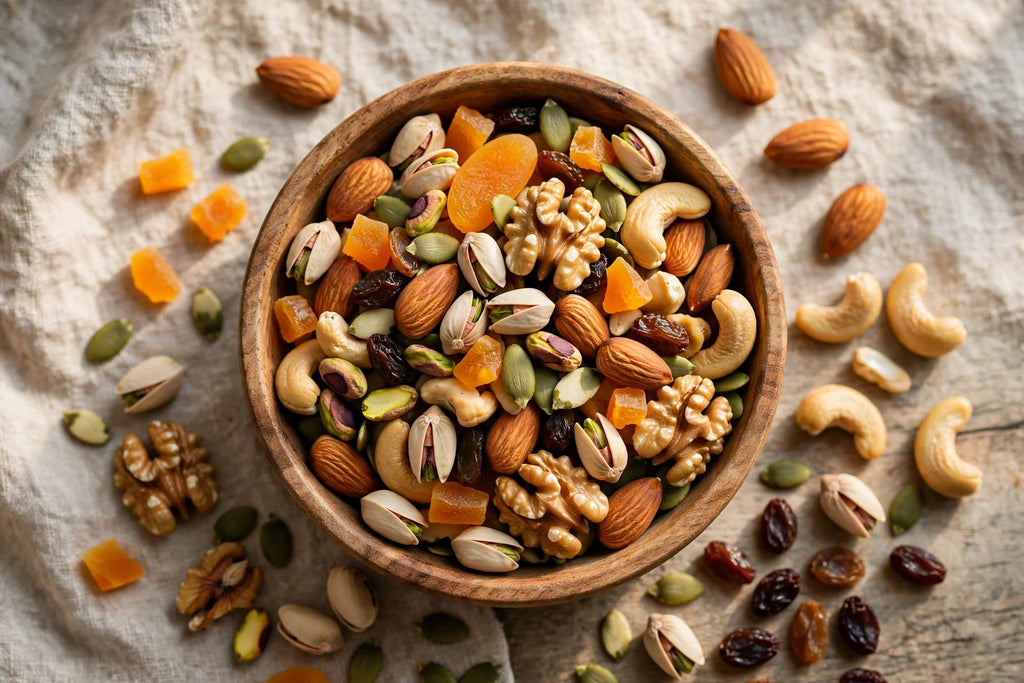
This version adds dry fruits to the plain porridge, and the dry fruits change it completely. Badam for crunch, kaju for softness, kishmish for sweetness, akhrot for depth, khajoor for the dark, caramel note, char magaz for the soft, milky bite — and a spoon of honey at the end, to bring it all together. The porridge is still porridge: warm, thick, comforting, eaten with a spoon. But now every spoonful has something in it, and the breakfast that used to be plain is now the best meal of the day.
One thing must be said plainly at the start, because it matters more than any recipe detail. Daliya is not sold on this shop, and it is not sold on the shop's other website either. It is a bazaar item — broken wheat, bought by the kilo from the atta shop or the kiryana store, the same place you buy rice and atta. This article does not cost it, because the shop does not sell it and its price varies by bazaar. The same is true of the milk: milk comes from the doodh-wala or the bazaar, not from a dry fruit shop, and it is not costed here either. Everything else — the badam, kaju, kishmish, akhrot, khajoor, char magaz and honey — comes from the shop, and every one of those is costed below at the live price.
The Ingredients: One Pot, Seven Shop Items
One pot — about 4 bowls — needs 1 cup daliya, 4 cups milk, 25g American badam, 25g raw kaju, 25g desi kishmish, 25g American akhrot giri, 50g mazafati khajoor, 25g char magaz, and 25g natural honey.
Two of these ingredients come from the bazaar, and it matters to say so plainly. Daliya and milk are bazaar-bought — the shop does not sell either — and neither is costed in this article, because their prices vary by bazaar and they are pantry staples most houses already keep. Everything else — the badam, kaju, kishmish, akhrot, khajoor, char magaz and honey — comes from the shop, and every one of those is costed below at the live price.
Each ingredient has a job. The daliya is the body of the porridge: broken wheat, simmered until it softens and thickens, it gives the bowl its warmth and its bulk. The milk is the medium: it turns the daliya from a grain into a porridge, and it gives the bowl its creaminess. The badam gives the crunch — chopped and stirred in at the end, it is the bite you notice first. The kaju gives the softness: it simmers tender and buttery, and it is the piece that makes the porridge feel rich. The kishmish gives the sweetness: it warms in the milk, swells slightly, and leaves small sweet pockets through the bowl. The akhrot gives the depth: its earthy flavour is the one that makes the porridge taste like a dry fruit porridge and not like plain daliya. The khajoor gives the dark, caramel note — chopped fine, it melts into the milk and sweetens the whole pot. The char magaz gives the soft, milky bite. And the honey, stirred in at the very end, off the heat, brings the sweetness together without cooking away.
Prepare the dry fruits before you start cooking. Chop the badam and kaju into small pieces, about the size of a pea, and break the akhrot into similar pieces. Rinse the kishmish and pat it dry. Chop the mazafati khajoor fine — remove the pits first, then chop until the pieces are small enough to melt into the milk. Keep the char magaz whole. The honey stays in the jar until the end: honey added to a boiling pot loses its flavour, and honey stirred in at the end keeps it.
The Method: Simmer, Stir, Serve Warm
Rinse the daliya, simmer it in milk on a low flame for twenty minutes, stir in the dry fruits, cook five minutes more, stir in the honey off the heat — and serve it warm, in bowls, straight away.
Start with the daliya. Rinse 1 cup of daliya in cold water, twice, until the water runs clear — this washes away the dust and the loose starch, and it is the difference between a clean porridge and a gluey one. Put the rinsed daliya in a heavy pot with the 4 cups of milk, and bring it to a gentle simmer over a medium flame. Do not let it boil hard: milk that boils hard catches at the bottom and burns, and burnt milk ruins a porridge that nothing can fix. Low flame, gentle simmer, and a stir every few minutes, scraping the bottom of the pot.
Simmer for twenty minutes, stirring regularly, until the daliya has softened and the porridge has thickened. The daliya should be tender when you press a grain between your fingers, and the porridge should coat the back of a spoon — thick, but still pourable, not a solid mass. If it gets too thick, add a splash of milk. If it is too thin, cook it five minutes more. Porridge is forgiving: it wants to be thick, and it will get there if you give it time and keep stirring.
Now stir in the dry fruits: the chopped badam, kaju and akhrot, the whole kishmish, the chopped khajoor and the char magaz. Cook for five minutes more, stirring, so the nuts warm through and the khajoor starts to melt into the milk. The kishmish will swell slightly, the khajoor will darken the porridge a shade, and the kitchen will smell of warm milk and toasted nuts. Take the pot off the heat, and stir in the 25g of honey. Taste it: if you want it sweeter, add another spoon of honey, but remember that the kishmish and the khajoor are already sweetening the pot, and the honey is the finish, not the foundation.
Serve it warm, in bowls, straight away. A bowl is a ladleful, about a cup, and that is the portion this article costs. Eat it with a spoon, slowly, while it is still steaming — porridge eaten cold is a different food, and a poorer one. If the porridge thickens as it sits, stir in a splash of warm milk before serving, and it will loosen again.
When to Eat It: Winter Mornings, School Days, Sick Days
The dry fruit daliya porridge's home is the winter breakfast table.
For school mornings, it is the best breakfast in this series. A bowl of porridge with dry fruits is a complete breakfast: the daliya gives steady energy, the milk gives protein, the nuts give richness, and the child leaves the house fed and warm. Make it the night before if the morning is rushed — cook the porridge, let it cool, store it in the fridge, and warm it in the morning with a splash of milk. It tastes nearly as good reheated, and the five minutes it saves in the morning are worth more than the small loss in texture.
For the older person in the house, the porridge is a gentle breakfast. It is soft, warm, easy to chew and easy to digest, and the nuts are chopped fine enough to eat without effort. For more on feeding older family members through winter, the shop's guide to dry fruits for the elderly covers soaked and ground options in detail. A small bowl, eaten slowly, is the right measure for a buzurg — not a large bowl, not a second helping, just a small bowl, warm, with chai afterwards.
For the rest of the house, the porridge is simply the winter breakfast. Make it on Sunday, and the pot covers Monday as well. Make it for the family, and the house smells of warm milk for the rest of the morning. It is not a celebration food, and it does not need to be: it is the food that makes an ordinary winter morning feel looked after.
The Costed Pot: Rs 147 a Bowl
Every price is the shop's own live price on 15 November 2026. The pot is costed by the amount used, from the verified pack price. Daliya and milk are bazaar-bought and not costed here — the shop does not sell either:
| Ingredient (Shopify store) | Pack price | Used in pot | Pot cost |
|---|---|---|---|
| American Badam | 250g Rs 1,100 | 25g | Rs 110 |
| Raw Kaju | 250g Rs 1,400 | 25g | Rs 140 |
| Desi Kishmish | 250g Rs 500 | 25g | Rs 50 |
| American Akhrot Giri | 250g Rs 800 | 25g | Rs 80 |
| Mazafati Khajoor | 250g Rs 400 | 50g | Rs 80 |
| Char Magaz | 250g Rs 780 | 25g | Rs 78 |
| Natural Honey | 250g Rs 500 | 25g | Rs 50 |
| Total — one pot (~4 bowls) | — | — | Rs 588 |
| Per bowl (4 per pot) | — | — | ~Rs 147 |
Rs 588 is the cost of the shop-bought ingredients for one pot of about 4 bowls — about Rs 147 a bowl. The daliya (1 cup) and milk (4 cups) are bazaar-bought and not in that total, because the shop does not sell them. The pantry to start — one 250g pack of each shop ingredient — costs Rs 5,480: badam 250g Rs 1,100, kaju 250g Rs 1,400, kishmish 250g Rs 500, akhrot giri 250g Rs 800, mazafati khajoor 250g Rs 400, char magaz 250g Rs 780 and honey 250g Rs 500. From that pantry you make the first pot and still have badam, kaju, kishmish, akhrot, khajoor, char magaz and honey left for many more pots — the nuts stretch far beyond one pot, because a pot uses only 25g of each. A half pot, about 2 bowls, costs Rs 294 in shop ingredients and is the right size for a small family, or for a first try.
Variations: Pista, Coconut, and Savoury
The dry fruit daliya porridge is the classic, but three variations are worth knowing, and all of them keep the recipe a one-line change.
With pista. Swap 25g of the badam for 25g of pista giri, chopped. The pista gives the porridge its green flecks and a richer, deeper flavour, and it makes the bowl look as good as it tastes. Pista giri is Rs 2,750 for 250g, so 25g costs Rs 275, and the pot becomes Rs 753, about Rs 188 a bowl. This version is noticeably more expensive, and it is the one to make for a weekend breakfast, or for guests, rather than for the everyday pot.
With coconut. Fold in 25g of dried coconut with the dry fruits. The coconut gives the porridge a soft, milky sweetness and a slightly chewy texture. Dried coconut is Rs 500 for 250g, so 25g costs Rs 50, and the pot becomes Rs 638, about Rs 160 a bowl. Use dried coconut, not fresh: fresh coconut carries water and makes the porridge thin in the wrong way.
Savoury. Leave out the khajoor and the honey, add a pinch of salt and a spoon of desi ghee, and the porridge becomes a savoury breakfast — the version for the person who does not want sweetness in the morning, or for the diabetic eater who wants the nuts without the sugar. The savoury pot costs Rs 458 in shop ingredients, about Rs 115 a bowl, and it is the version to make when the sweet porridge feels like too much. Serve it with a boiled egg, and it is a complete breakfast.
Do not add sugar to the porridge. The kishmish, the khajoor and the honey sweeten it already, and sugar on top of that makes it a dessert, not a breakfast. If the pot tastes less sweet than you expected, that is correct — it is a breakfast, and a breakfast should not taste like a sweet. The palate adjusts in a week, and the family will start to taste the nuts more and miss the sugar less.
Keeping Porridge, Making It Ahead
Dry fruit daliya porridge keeps for two days in the fridge, in a sealed dabba, and it reheats well with a splash of milk. Let the porridge cool completely before you put it in the fridge, and seal the dabba properly — porridge left open in the fridge dries out and picks up smells. To reheat, put the porridge in a pot with a splash of milk, warm it on a low flame, and stir until it loosens and steams. Do not microwave it dry: the microwave makes porridge hard at the edges and cold in the middle, and a pot with milk is kinder to it.
Do not freeze porridge. The daliya goes grainy when it thaws, and the milk separates, and a thawed porridge is a poor porridge. Two days in the fridge is the limit, and that is enough: a pot made on Sunday covers Monday, and a pot made on Monday covers Tuesday, and that is the rhythm of a breakfast that is meant to be made fresh, often, and in small pots.
One last note for the maker: make porridge on a morning when you have half an hour and a free stove. It is the simplest breakfast in this series, and it is the one to make when the granola feels like too much work and the cookies feel like too much waiting. Half an hour, seven shop ingredients, four bowls — and the house smells of warm milk and toasted badam for the rest of the morning.
Is daliya sold on Khan Dry Fruits?
No — daliya (broken wheat) is not sold on this shop or on the shop's other website. It is a bazaar item, bought by the kilo from the atta shop or kiryana store, and this article does not cost it. Milk is also bazaar-bought and not costed here.
How much does dry fruit daliya porridge cost per bowl?
Rs 588 in shop-bought ingredients for about 4 bowls, about Rs 147 each — badam 25g Rs 110, kaju 25g Rs 140, kishmish 25g Rs 50, akhrot giri 25g Rs 80, mazafati khajoor 50g Rs 80, char magaz 25g Rs 78 and honey 25g Rs 50. Daliya and milk are bazaar-bought and not in that total.
Can I make the porridge the night before?
Yes — cook it, let it cool, store it in a sealed dabba in the fridge, and warm it in the morning with a splash of milk. It tastes nearly as good reheated, and it keeps for two days in the fridge. Do not freeze porridge; the daliya goes grainy when it thaws.
What is the difference between daliya porridge and dry fruit granola?
Porridge is soft, warm and cooked in milk, made fresh in a pot for the breakfast table. Granola is crunchy, baked with oats and honey, and kept in a jar for the week. Same dry fruits, different breakfast — porridge is the warm one, granola is the crunchy one.
Can I make a savoury version without honey and khajoor?
Yes — leave out the khajoor and honey, add a pinch of salt and a spoon of desi ghee, and the pot costs Rs 458 in shop ingredients, about Rs 115 a bowl. It is the version for the person who does not want sweetness in the morning, served with a boiled egg for a complete breakfast.
Cook Your Daliya Porridge: Order from Khan Dry Fruits — American badam 250g (Rs 1,100), raw kaju 250g (Rs 1,400) and natural honey 250g (Rs 500). Delivery across Pakistan. Browse the News blog →
Related: Homemade Dry Fruit Granola: Oats, Honey & Nuts · Dry Fruit Kheer Recipe · Dry Fruits for Elderly: Soft, Easy Winter Guide


