


 Gift Box
 Almonds
 Cashew Nuts
 Pistachio
 Pine Nuts Chilgoza
 Walnuts
 Dried Fig
 Apricot
 Dates
 Peanuts
 Walnut Kernels


Homemade Dry Fruit Granola: Oats, Honey & Nuts Recipe
In short: Granola is the baked, crunchy cousin of the breakfast bowl: oats tossed with honey, badam, kaju, akhrot, kishmish and seeds, baked golden in the oven, and kept in a jar for weeks. One batch makes about 12 bowls and costs Rs 1,860 in shop-bought ingredients — about Rs 155 a bowl. The oats come from the bazaar, not from this shop, so they are not costed here. Spoon it over dahi, eat it with doodh, or keep a jar on the desk for a crunchy snack.
There are two kinds of oat breakfasts, and they are easy to confuse. One is the overnight oats — oats soaked in milk overnight, soft, cold, ready in the morning without cooking. The shop's overnight oats guide covers that one properly, and this article does not repeat it. The other is granola: oats baked in the oven with honey and nuts until they turn golden and crisp, then kept in a jar and eaten by the spoonful for weeks. Same family, different character — one is soft and cold, the other is crunchy and warm, and the crunchy one is what this article is about.
Granola is a newer food in the Pakistani kitchen than pinni or laddu, and it arrived the way many foods arrive now: through a friend, a café, a packet bought once and liked enough to make at home. The packet version is expensive — a small bag of imported granola costs more than the whole jar you make at home — and the homemade version is better in every way that matters: you choose the nuts, you choose the honey, you control the sweetness, and the jar lasts longer than the packet ever did. It is also, honestly, one of the easiest bakes there is. If you can toss a salad, you can make granola.
What granola is good for is breakfast and snacking. A bowl of granola over dahi, with a sliced banana, is a complete breakfast that takes one minute to serve. A small bowl with doodh is the same. A handful from the jar, eaten dry at the desk or in the car, is the snack that replaces the biscuit packet. It is not a sweet in the way pinni is a sweet — the honey is a coating, not the main event — and it is not a health food in the way a plain handful of nuts is. It is a breakfast food, a jar food, and a good one.
What Goes In: The Batch
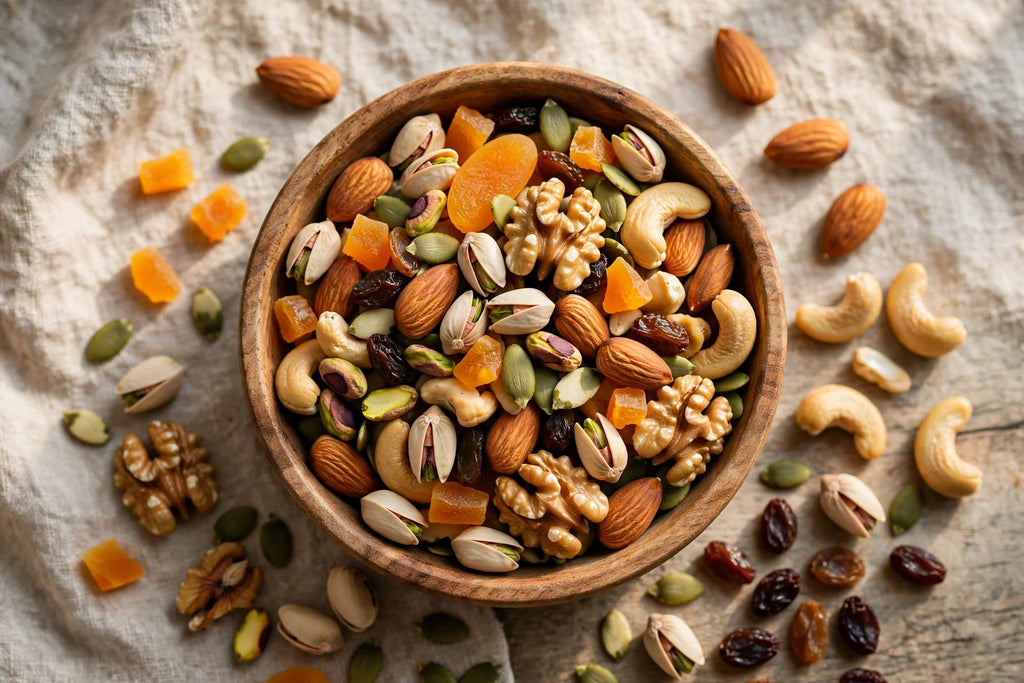
One batch — about 600g, or 12 bowls of 50g — needs 300g oats, 100g natural honey, 100g badam, 100g kaju, 50g American akhrot giri, 100g desi kishmish, 50g raw sunflower giri and 50g green pumpkin seeds.
One ingredient comes from the bazaar, and it matters to say so plainly. Oats are not sold on this shop, or on the Laravel shop either — no oats product exists in either catalogue — so buy your oats from your usual bazaar or supermarket source, 300g of plain rolled oats, and they are not costed in this article. Everything else — the honey and every nut and seed — comes from the shop, and every one of those is costed below at the live price.
Each ingredient has a job in the jar. The oats are the base and the crunch: they toast golden in the oven and carry everything else. The honey is the binder and the sweetness: it coats the oats and the nuts and hardens as it cools, giving the granola its clusters. The badam and kaju are the big, satisfying pieces. The akhrot is the deep flavour. The kishmish is the sweetness that survives the baking — add it in the last ten minutes, so it warms and softens without burning. The sunflower giri and the pumpkin seeds are the small, crisp seeds that fill the gaps and give the granola its variety in every spoonful.
Use rolled oats, not instant oats: instant oats turn to dust in the oven, and rolled oats hold their shape and crisp up properly. Roughly chop the badam and kaju into halves and quarters, break the akhrot into pieces, and leave the seeds whole. The kishmish goes in whole, at the end.
The Method: Toss, Bake, Cool
Toss the oats, nuts and seeds with warmed honey, spread thin on a tray, and bake at a low heat — about 150°C — for 25 to 30 minutes, stirring twice, until golden. Add the kishmish in the last ten minutes. Cool completely before jarring.
Start by warming the honey. Put the 100g of natural honey in a small pan on a low flame, just until it loosens and flows — thirty seconds is enough. Do not boil it: hot honey is enough, and boiled honey darkens and tastes bitter. Pour the warm honey over the oats, badam, kaju, akhrot, sunflower giri and pumpkin seeds in a big bowl, and toss well with a spoon until everything is lightly coated. The mixture should look glossy, not wet — a thin coat of honey on every piece, not a pool at the bottom of the bowl.
Spread the mixture thinly on a baking tray lined with butter paper. Thin is important: a thick layer steams instead of baking, and the middle stays soft while the edges burn. One even layer, no piles, no bare patches. Put the tray in the oven at about 150°C — a low, gentle heat — and bake for 25 to 30 minutes, taking the tray out twice to stir. The stirring is what makes granola even: it turns the pieces so every side toasts, and it breaks up the clumps before they set hard.
After fifteen minutes, when the mixture is starting to turn gold, sprinkle the 100g of kishmish over the top and stir it in, then return the tray for the last ten minutes. Kishmish added at the start would burn and turn bitter; kishmish added at the end warms, softens, and stays sweet. The granola is done when it is golden all over and smells of toasted oats and honey. Take it out, and — this is the part people skip — let it cool completely on the tray before you touch it. Hot granola is soft. Cool granola is crisp. The crunch happens as it cools, and a granola jarred warm goes soft in the jar.
Once cool, break the sheet into clusters — some big, some small — and store in an airtight jar. It keeps for three weeks at room temperature, and the jar is the point: make it once, eat it for weeks.
How to Eat Granola: Dahi, Doodh, or By the Handful
The best way to eat granola is over dahi: a bowl of plain dahi, a handful of granola on top, and a sliced banana if you have one.
The dahi version is the complete breakfast: the dahi gives protein and coolness, the granola gives crunch and energy, and the banana gives sweetness and bulk. It takes one minute to serve, it needs no cooking in the morning, and it is the breakfast for a house where mornings are busy and nobody has time to cook. Make the granola on Sunday, and the week's breakfasts serve themselves.
With doodh, granola eats like a cereal: pour cold doodh over a bowl, eat it straight away, before the granola softens. It is the children's favourite version, and it is a better cereal than the sweetened packets — real nuts, real honey, no colours, no flavours added. For children, keep the serving to a small bowl, and chop the nuts a little finer for younger ones.
By the handful, granola is the desk snack and the car snack: a small jar or a paper cone of granola, eaten dry, is the thing that replaces the biscuit packet and the namkeen packet. It is more filling than either, and it is the snack you can feel good about keeping in the drawer. A handful — about 30g — is the right snack measure. A bowlful as a snack is a meal, and it should be counted as one.
Granola also works as a topping: over kheer, over custard, over a fruit salad, over ice cream on a winter evening when the house wants something special. A spoonful on top of anything soft gives it crunch, and the crunch is what makes the topping worth it.
The Costed Batch: Rs 155 a Bowl
Every price is the shop's own live price on 14 November 2026. The batch is costed by the amount used, from the verified pack price. Oats are bazaar-bought and not costed here — the shop does not sell them:
| Ingredient (Shopify store) | Pack price | Used in batch | Batch cost |
|---|---|---|---|
| Natural Honey | 250g Rs 500 | 100g | Rs 200 |
| American Badam | 250g Rs 1,100 | 100g | Rs 440 |
| Raw Kaju | 250g Rs 1,400 | 100g | Rs 560 |
| American Akhrot Giri | 250g Rs 800 | 50g | Rs 160 |
| Desi Kishmish | 250g Rs 500 | 100g | Rs 200 |
| Raw Sunflower Giri | 250g Rs 850 | 50g | Rs 170 |
| Green Pumpkin Seeds | 250g Rs 650 | 50g | Rs 130 |
| Total — one batch (~600g, 12 bowls) | — | — | Rs 1,860 |
| Per bowl (50g serving) | — | — | Rs 155 |
Rs 1,860 is the cost of the shop-bought ingredients for one batch of about 600g — twelve 50g bowls at Rs 155 each. The oats (300g) are bazaar-bought and not in that total, because the shop does not sell them. The pantry to start — one 250g pack of each shop ingredient — costs Rs 5,800: honey 250g Rs 500, badam 250g Rs 1,100, kaju 250g Rs 1,400, akhrot giri 250g Rs 800, kishmish 250g Rs 500, sunflower giri 250g Rs 850 and pumpkin seeds 250g Rs 650. From that pantry you make the first batch and still have honey, badam, kaju, akhrot, kishmish and seeds left for a second batch — the only thing to top up is the honey. A half batch, about 300g or six bowls, costs Rs 930 in shop ingredients and is the right size for a small family trying granola for the first time.
Granola vs Overnight Oats: Which Breakfast Is Yours?
Granola is baked and crunchy; overnight oats are soaked and soft. The difference is texture, time, and keeping.
Overnight oats take five minutes at night and no oven: oats, milk, nuts and seeds in a jar, into the fridge, and the morning serves itself cold and soft. Granola takes half an hour in the oven once, and then serves for three weeks from a jar. If your mornings are rushed and your evenings are free, granola is the better system: one bake, three weeks of one-minute breakfasts. If you have no oven, or you prefer a cold, soft breakfast, overnight oats are the better one — and the shop's overnight oats guide is the recipe to follow.
The two also differ in the eating. Overnight oats are a bowl food, eaten with a spoon, soft and filling. Granola is a jar food, eaten by the handful as often as by the bowl, crunchy and snackable. A house that keeps both has a breakfast for every mood: the soft jar for slow mornings, the crunchy jar for busy ones. The pantry is nearly the same for both — badam, kaju, akhrot, kishmish, seeds and honey — so the two recipes share one shopping list, and that is a practical kindness.
One more difference matters: keeping. Overnight oats keep a day, maybe two, in the fridge. Granola keeps three weeks in a jar on the shelf. If you travel, or if the house eats breakfast at different times, the jar wins. If you eat together, at the table, every morning, the overnight jar wins on freshness. Choose by your house's rhythm, not by a claim that one is healthier — both are real food, made from the same ingredients, and the healthier one is the one you actually eat.
Keeping Granola, Gifting Granola
Granola keeps for three weeks in an airtight jar at room temperature. Keep the jar sealed, cool, and dry — not near the stove, not in sunlight. The granola's enemy is damp, the same as the laddu's: a jar left open in a humid kitchen goes soft in a day. If the granola does soften, spread it on a tray and bake it for five minutes at a low heat, and it crisps up again.
Do not refrigerate granola. The fridge adds damp and dulls the crunch, and a cold granola is a soft granola. Room temperature, sealed jar, is right — and the jar should be glass, not plastic, because glass keeps the crunch better and lets you see how much is left.
Granola is also a good gift, and a modern one: a glass jar of homemade granola, tied with a ribbon, is a gift that says you cook, and it is a gift that gets eaten rather than put on a shelf. Give it to a friend who has just moved, to a colleague who skips breakfast, to a student going back to a hostel. The jar is the gift and the breakfast inside it is the second gift. And for the house that sends food to family abroad, granola travels well: it keeps three weeks, it needs no fridge, and it arrives as a taste of home that is also a breakfast.
How long does homemade granola keep?
Three weeks in an airtight jar at room temperature, kept cool and dry. Do not refrigerate — the fridge adds damp and dulls the crunch. If the granola softens, bake it for five minutes at a low heat and it crisps up again.
Can I make granola without an oven?
The oven is what makes granola crunchy, and the baked version is the one in this recipe. Without an oven, the no-bake cousin is overnight oats — oats soaked in milk overnight, soft and ready in the morning. The shop's overnight oats guide covers that recipe, and it needs no oven at all.
How much does a batch of granola cost?
Rs 1,860 in shop-bought ingredients for about 600g — twelve 50g bowls at Rs 155 each. Oats are bazaar-bought and not in that total, because the shop does not sell them. A half batch of six bowls costs Rs 930 in shop ingredients.
What is the difference between granola and overnight oats?
Granola is baked and crunchy, made once and kept in a jar for three weeks. Overnight oats are soaked and soft, made the night before and eaten cold the next morning. Same family, different texture — granola is the crunchy jar food, overnight oats the soft bowl food.
Is granola good for children?
Yes — a small bowl with doodh is a good breakfast for a child, and a handful is a better snack than a biscuit packet. Chop the nuts a little finer for younger children, and keep the serving to a small bowl: granola is an energy food, and a small bowl is the right measure.
Make Your Granola Batch: Order from Khan Dry Fruits — natural honey 250g (Rs 500), American badam 250g (Rs 1,100) and raw kaju 250g (Rs 1,400). Delivery across Pakistan. Browse the News blog →
Related: How to Make Overnight Oats with Nuts, Seeds & Dry Fruits · Best Dry Fruits for Winter in Pakistan · Dry Fruits for Skin and Hair


